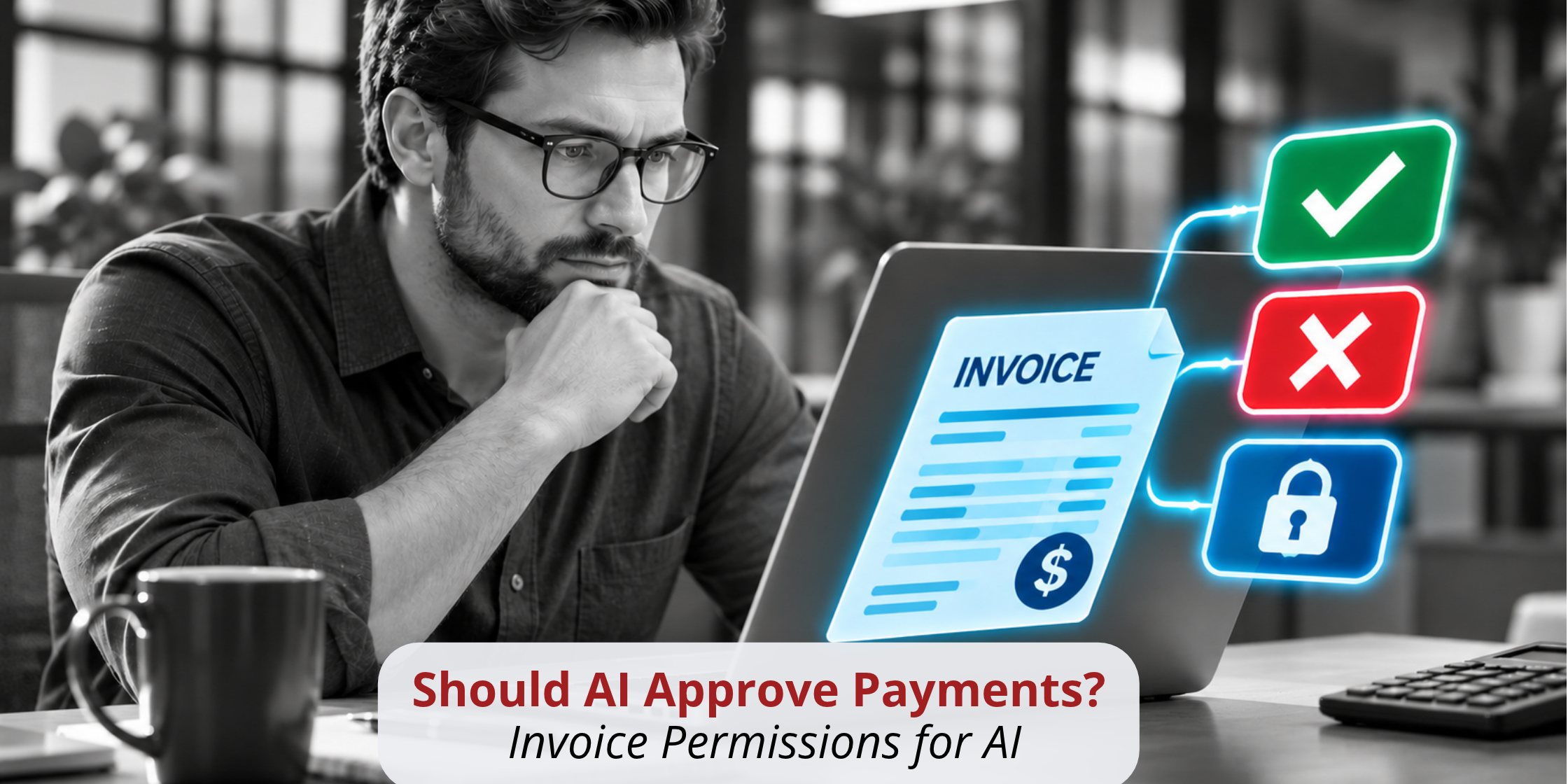
AI Security Controls, Part 2 of 4: AI can transform accounts payable. It should never hold the keys to your bank account.
Accounts payable is one of the most tempting places to put an AI agent. The work is repetitive, rules-based, and high volume. Reading invoices, matching them to purchase orders, and flagging exceptions is exactly what agents do well.
Paying those invoices is a different job. The moment an agent can move money on its own, it becomes the most valuable target in your company.
The short answer: No. Let AI agents read invoices and draft payment recommendations. Do not let them approve payments, change banking details, or execute payments without human verification. Business email compromise cost U.S. victims about $3 billion in 2025, and attackers now use AI to find exactly the payment approvals an agent would control. [1][2]
Why are payments the highest-risk job for an AI agent?
Because payment fraud is already the most profitable business attack. The FBI’s Internet Crime Complaint Center reported roughly $3 billion in business email compromise losses in 2025, the second-largest loss category in its annual report. [1] For the first time, the report also broke out complaints referencing AI: more than 22,000 complaints with about $893 million in losses. [1]
Business email compromise works by impersonating a vendor or executive and redirecting a payment. Now picture an agent with authority to change a vendor’s bank account and release funds. One convincing email, one manipulated invoice, and the fraud executes itself.
Attackers are using AI to find your payment process
This is not theoretical. In September 2026, Microsoft’s Digital Crimes Unit disrupted EvilTokens, a cybercrime service whose AI chatbot analyzed compromised inboxes to identify trusted relationships, payment authorizations, and the circumstances where fraud was most likely to succeed. [2]
Attackers have automated the search for your weakest payment approval. Do not make it an agent.
The five invoice permissions every finance team should set
Allow:
- Read invoices. Let the agent extract vendor, amount, due date, and line items. This is where the time savings live.
- Create draft recommendations. Let the agent match invoices to purchase orders, flag duplicates and exceptions, and prepare a payment batch for review.
Do not allow:
- Approving payments autonomously. A human approves every payment. No exceptions for “small” amounts.
- Changing banking details. Vendor bank account changes are the core mechanic of payment fraud. Keep them out of the agent’s reach entirely.
- Executing payments without verification. Every release of funds requires a human check outside the agent’s workflow.
This structure follows OWASP’s guidance for AI agents: grant only the functions the task needs, use read-only access wherever possible, and require human approval for high-impact actions. [3]
How should humans verify payment changes?
Verify outside the channel the request came in on. The U.S. Department of Commerce Office of Inspector General advises organizations to independently verify every request to change banking or payment information by contacting a known person through a previously established method, never a phone number contained in the request. [4] It also recommends dual approval and separation of duties for payment setup, banking changes, and wire or ACH transfers. [4]
An agent can prepare the verification task. It cannot be the verification.
What about the data the agent reads?
Invoices are untrusted input. They arrive from outside your organization and can carry hidden instructions meant for an AI reader. CISA’s joint guidance on agentic AI warns against granting agents broad or unrestricted access to sensitive data or critical systems and calls for strict least privilege. [5] Treat every invoice an agent reads as potentially hostile, and keep the agent’s permissions narrow enough that a manipulated document cannot trigger a payment.
The rest of the AI Security Controls series
- Part 1: Why AI Agents Go Rogue and the 5 Controls That Prevent It
- Part 3: What to Do When an AI Agent Makes a Mistake: A 4-Step AI Incident Response Plan
- Part 4: Does Your Microsoft License Protect You? Why Entitlement Is Not Security Coverage
The bottom line
Put AI to work where it saves time: reading, matching, and recommending. Keep people in charge where money moves. Read and draft are yes. Approve, change, and pay are no.
Advanced Business Solutions helps finance and operations teams in Louisville, Lexington, and across the region design AI workflows with the right permissions from day one. If you are evaluating AI for accounts payable, talk to our team before the agent touches a payment.
Frequently Asked Questions
Sources
[1] Federal Bureau of Investigation, Internet Crime Complaint Center (IC3), “2025 Internet Crime Report”: https://www.ic3.gov/AnnualReport/Reports/2025_IC3Report.pdf
[2] Microsoft On the Issues, “Disrupting EvilTokens: The AI Chatbot Built for Cybercrime,” September 22, 2026: https://blogs.microsoft.com/on-the-issues/2026/09/22/disrupting-eviltokens-the-ai-chatbot-built-for-cybercrime/
[3] OWASP Foundation, “LLM06:2025 Excessive Agency,” OWASP Top 10 for LLM Applications: https://genai.owasp.org/llmrisk/llm062025-excessive-agency/
[4] U.S. Department of Commerce, Office of Inspector General, Fraud Alert, July 2026: https://www.oig.doc.gov/wp-content/OIGPublications/DOC-OIG-Fraud-Alert-July-2026-Approved.pdf
[5] Cybersecurity and Infrastructure Security Agency (CISA), “Careful Adoption of Agentic AI Services”: https://www.cisa.gov/resources-tools/resources/careful-adoption-agentic-ai-services