IT selects, secures, and governs the tools. HR makes adoption stick. A perspective from Hanna Resource Group and Advanced Business Solutions.
Most organizations treat AI as a technology rollout. IT evaluates the platforms, secures the environment, assigns licenses, and announces that the tools are live. Then adoption stalls. Some employees never open the tool, others keep using personal accounts, and leadership cannot point to a measurable result. The missing piece is rarely technical. It is HR and IT collaboration on AI from the first decision forward.
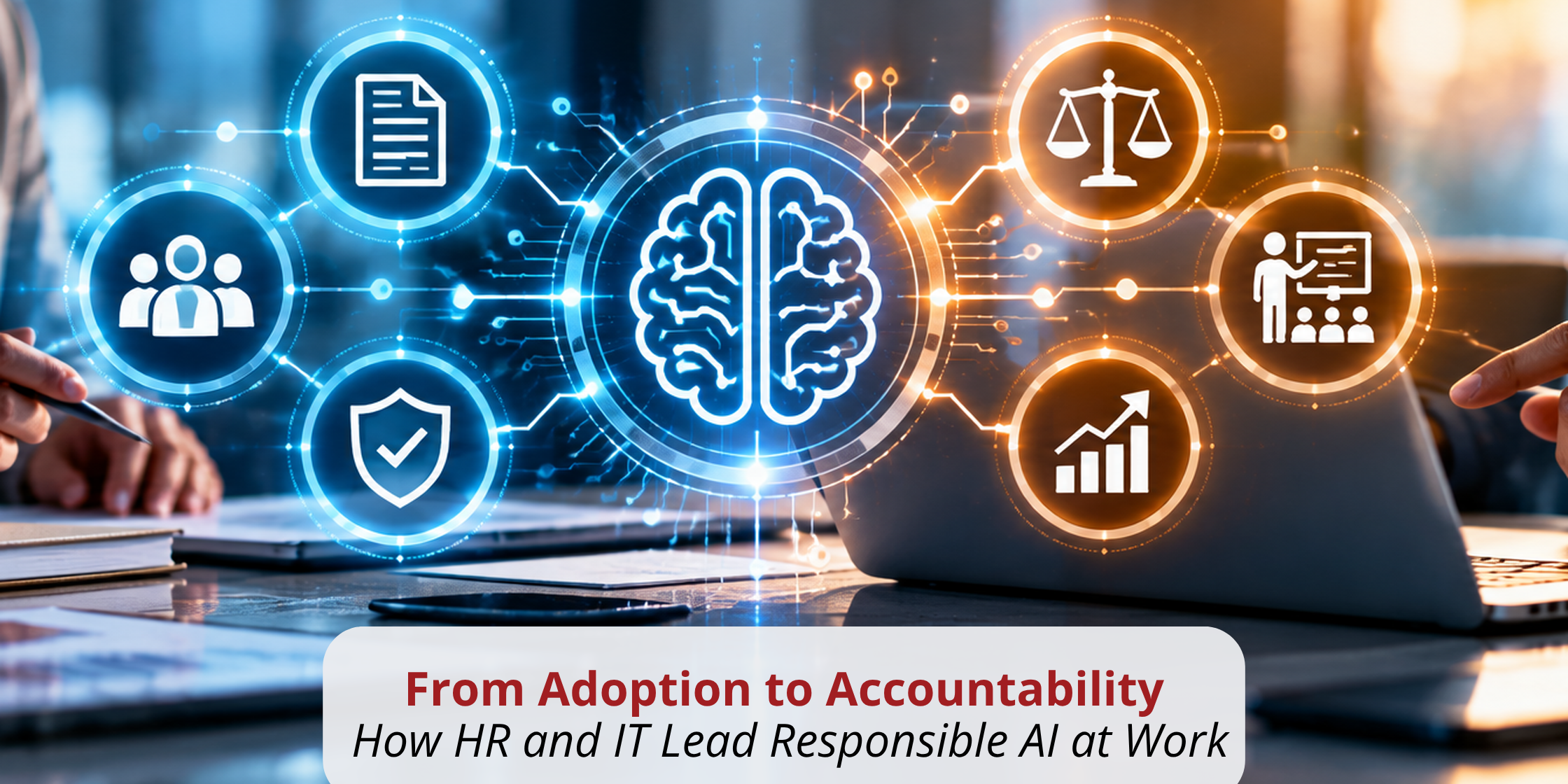
The argument here is straightforward. AI adoption is a change initiative as much as a technology project. IT can select, secure, and govern the tools, while HR drives the change by setting expectations, developing policy, and helping employees adopt AI the right way. Real AI success happens when both teams lock arms. That is the perspective Kentucky-based Hanna Resource Group (HRG) and Advanced Business Solutions (ABS) have built by working the people side and the technology side of AI together.
Key takeaways
- Access is not adoption. Turning on AI tools without a people plan leaves both value and risk unmanaged.
- IT answers whether AI can be used safely: tool selection, security, data protection, and governance.
- HR answers whether people will use AI well: change management, expectations, policy, training, and manager support.
- Managers make the difference. Employees whose manager actively supports AI use are engaged at 48%, compared with 30% for those whose manager does not.[1]
Why do AI rollouts stall after the tools are turned on?
Because access is not the same as adoption. Leaders sensed the gap early: in Microsoft and LinkedIn’s 2024 Work Trend Index, 60% of leaders worried their company lacked a plan and vision to implement AI, even as employees moved ahead without one.[2] A license tells employees a tool exists. It does not tell them what the tool is for in their job, what they are allowed to put into it, or whether their manager expects them to use it.
The productivity data makes the point. Among AI users in organizations that have adopted AI, only 17% give it the highest rating for impact on their productivity. When their manager actively supports AI use, that figure rises to 33%, compared with 9% when the manager does not.[1] The technology is the same in both groups. The difference is the people work around it, and that work belongs to HR.
What does IT own in AI adoption?
IT owns whether AI can be used safely. That starts with selecting the right platform for the organization’s ecosystem, budget, and compliance needs rather than defaulting to whichever tool is generating headlines. It continues with preparing the environment. Integrated AI assistants surface whatever a user already has permission to see, so file permissions and data access need review before launch, not after an employee stumbles onto a document they were never meant to find. IT then governs the tools over time through identity and access controls, vendor review, an approved tool list backed by technical controls, and monitoring that produces usage, shadow AI, and adoption reports.
That work is essential, and it is incomplete on its own. IT can make the right tool available and safe. It cannot make anyone want to use it, define what good use looks like in a specific role, or answer the employee who is worried AI will replace them.
What does HR own in AI adoption?
HR owns whether people will use AI well. AI adoption is a behavior change, and HR is the function built to lead behavior change at scale. That means setting expectations by role, so employees know where AI is encouraged, where it is off limits, and how it factors into performance conversations. It means developing the acceptable use policy in plain language and enforcing it consistently. It means building AI into training and onboarding, and equipping managers to coach AI use week to week.
HR also manages the human reaction to AI, which no technical control can reach. Employees want to know what AI means for their jobs, and the honest answer is more nuanced than the headlines. SHRM’s 2026 research found that 39% of organizations report shifts in job responsibilities from AI and 57% report more upskilling and reskilling opportunities, while just 7% report job displacement.[3] HR is the function that can deliver that message credibly, and the one accountable for making the upskilling real.
What happens when HR or IT goes it alone?
When IT leads alone, organizations get tools without trust. Licenses go unused, employees keep their personal accounts, and the business case for the investment quietly falls apart. When HR leads alone, organizations get enthusiasm without a safe place to put it: employees are encouraged to experiment before anyone has confirmed which tools are secure or what data they can use.
Today the more common gap is HR’s absence from the people side of adoption. In SHRM’s 2026 research, only 28% of organizations say HR is leading AI upskilling efforts, and 56% of HR functions do not formally measure the success of their AI investments.[3] That leaves the change management half of AI adoption without a clear owner or a scoreboard.
What does HR and IT collaboration on AI look like in practice?
Collaboration does not mean every decision is made jointly. It means each team owns its half of the adoption journey and hands off cleanly at every stage.
| Adoption stage | IT’s role | HR’s role |
|---|---|---|
| Choose the tool | Evaluate fit with the ecosystem, security, and licensing | Identify the roles and workflows that will benefit most |
| Prepare the organization | Review permissions and configure access | Plan change communications and address job-security concerns |
| Launch | Enable licenses and data protections | Set role-based expectations and deliver training |
| Coach | Provide support and usage data by team | Equip managers to coach AI use in one-on-ones |
| Measure | Report usage and adoption trends | Measure employee confidence, engagement, and feedback |
A standing HR and IT check-in keeps the handoffs working. Once a month, put IT’s usage data next to HR’s employee feedback and ask one question: where is adoption lagging, and is the cause a tool problem or a people problem? IT fixes the first, HR fixes the second, and both teams see results the same month. For the governance side of this partnership, including the policy and a 90-day plan, see Responsible AI in the Workplace Is a Shared Job.
Why does this matter for Kentucky employers?
Many mid-sized employers in Central Kentucky and the Louisville area do not have a dedicated chief people officer and a chief information officer on staff. The responsibilities still exist, so the partnership has to come from somewhere. HRG supports the people side, from HR assessments and outsourcing to organizational development. ABS supports the technology side through its AI Enablement practice, helping organizations build a clear roadmap, establish governance, train users, and implement the right tools. Together, the two firms give employers both halves of AI adoption without asking either team to work outside its expertise.
The bottom line
AI adoption succeeds or stalls on the partnership behind it. IT makes AI possible and safe, while HR makes it understood, expected, and used well. Bring the two teams together before the first license is assigned, and the AI tools you already pay for start delivering the value you bought them for.
Frequently Asked Questions
Hanna Resource Group is a Kentucky HR consulting firm focused on compensation, HR outsourcing, talent acquisition, HR assessment, and organizational development. Advanced Business Solutions is a managed IT, cybersecurity, and AI consulting firm with offices in Louisville and Lexington.
Contact Advanced Business Solutions:
- Phone: 502-896-2557
- Web: AdvancedBusinessSolutions.com
- Office: 348 E Main Street, Lexington, KY 40507
Sources
[1] Gallup, “Employee Engagement Remains Flat as AI Adoption Accelerates,” July 21, 2026 (engagement and productivity ratings by manager support): https://www.gallup.com/workplace/712433/employee-engagement-remains-flat-adoption-accelerates.aspx
[2] Microsoft, “Microsoft and LinkedIn release the 2024 Work Trend Index on the state of AI at work,” May 8, 2024 (60% of leaders worry their company lacks an AI plan and vision): https://blogs.microsoft.com/blog/2024/05/08/microsoft-and-linkedin-release-the-2024-work-trend-index-on-the-state-of-ai-at-work/
[3] SHRM, “The State of AI in HR in 2026: 5 Critical Insights for CHROs,” April 3, 2026 (HR-led upskilling, AI measurement, and workforce impact): https://www.shrm.org/executive-network/insights/state-of-ai-hr-2026-5-critical-insights-chros