Quick Answer Manufacturers and suppliers in Lexington and Central Kentucky face IT and compliance demands that generic managed IT support often misses — OEM supplier security requirements, plant-floor uptime expectations, and separation between operational technology (OT) and business IT. In a 2025 survey of Lexington-area businesses, security and compliance ranked as the single most important factor when choosing an IT provider, and 86% said compliance readiness as a service was an appealing offering.
Why Lexington and Central Kentucky Manufacturers Have Different IT Needs
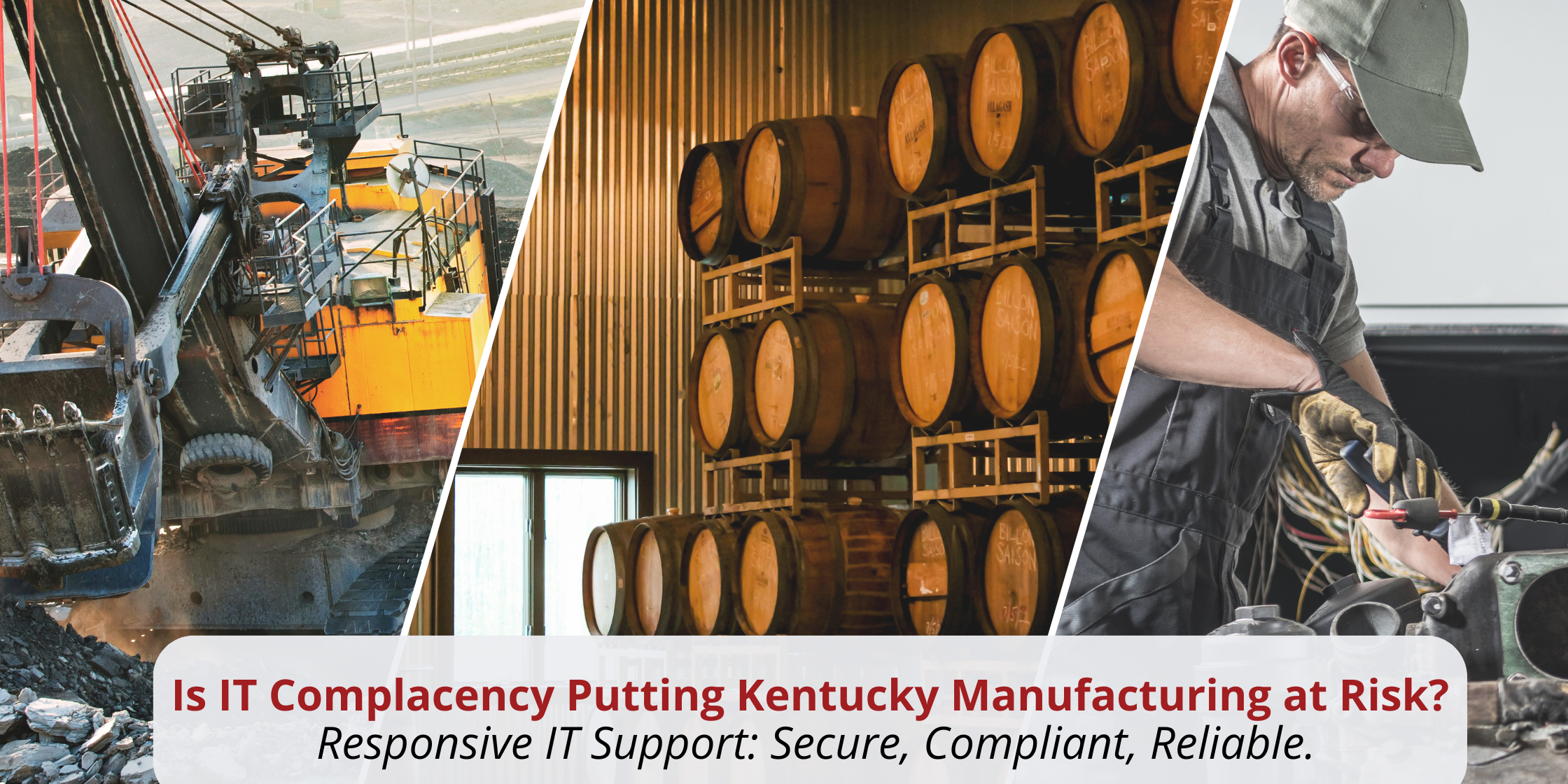
Central Kentucky carries one of the state’s densest manufacturing and supplier footprints. The automotive supply chain concentrated around Georgetown and Scott County, the bourbon and beverage production corridor running through Woodford, Franklin, and Bourbon counties, and the advanced manufacturing and distribution operations spread across Nicholasville, Richmond, Winchester, Versailles, Danville, and Berea all share a common profile: production environments where downtime is measured in dollars per minute.
These businesses run differently than a typical office environment. Production lines cannot tolerate unplanned outages. Legacy equipment on the plant floor was often installed long before cybersecurity was a design consideration. And supply-chain relationships increasingly arrive with security expectations attached.
A managed IT provider built around office help desk support will often miss these realities. Manufacturers and suppliers across the Bluegrass region need a partner that understands plant-floor risk, not just email and file servers.
What Lexington-Area Businesses Say They Prioritize
Advanced Business Solutions commissioned independent research in 2025 surveying small and mid-sized business decision-makers across five markets, including Lexington. The Lexington findings are direct:
| Lexington finding | Result |
|---|---|
| Rank security and compliance as the top factor when choosing an IT provider | #1 factor (45%) |
| Take IT security and cybersecurity extremely seriously (rated 5 of 5) | 63% |
| Interested in cybersecurity services, including assessments and managed support | 72% |
| Find “compliance readiness as a service” somewhat or very appealing | 86% |
| Interested in strategic IT planning — the highest of the five markets studied | 64% |
| Interested in data management — backup, disaster recovery, and monitoring | 67% |
For a manufacturer or supplier, that pattern is telling. Security, compliance readiness, and long-term IT planning are exactly the areas where production environments carry the most exposure — and Lexington-area decision-makers are asking for them at a higher rate than businesses in comparable markets.
Supplier Security Requirements: What OEM Partners Expect
Manufacturers and suppliers that sell into automotive, defense, or other structured supply chains are increasingly asked by their OEM partners to demonstrate cybersecurity maturity — often through a vendor questionnaire, a security assessment, or alignment with a recognized framework.
- NIST 800-171 — common for suppliers handling controlled or sensitive information
- ISO 27001 — an internationally recognized information security management standard
- CMMC awareness — relevant for suppliers connected to defense-related supply chains
- Vendor security questionnaires — increasingly required as a condition of doing business with larger OEMs
Requirements vary by OEM and by contract, so suppliers should confirm current expectations directly with their partners rather than assuming a single standard applies. What does not vary is the timeline: these requests usually arrive with a deadline attached.
OT and IT: Why Plant-Floor Systems Need a Different Security Approach
Operational technology (OT) — the systems that run production equipment, industrial controls, and plant-floor sensors — has different priorities than business IT. Uptime typically outweighs patching speed, and equipment can run on older operating systems that were never designed to be internet-connected.
Segmenting OT networks from business IT networks limits how far an incident can spread. A compromised office laptop should not be able to reach a production controller, and a plant-floor device should not sit on the same network as financial systems. This separation is one of the most common gaps IT and compliance reviews uncover in manufacturing environments.
Uptime and Response Time: A Different Standard Than Office Environments
When a production line goes down, the cost compounds by the minute in a way an office outage does not. Manufacturers should expect — and should ask for — response time commitments calibrated to production impact, not a generic office-support SLA.
Lexington-area businesses put a high value on this: 87% rated guaranteed response times in service level agreements as an appealing offering, and 24/7 availability ranked as one of their top three provider selection factors. For a plant running extended or around-the-clock shifts, that expectation is not a preference — it is a requirement.
The Industry Expertise Gap in Central Kentucky
One of the more striking findings in the Lexington research: of the five markets studied, Lexington respondents reported the lowest satisfaction with their current IT provider across every category measured — including industry expertise, where satisfaction sat at 64% against a five-market average of 78%. Satisfaction with range of services (57%) and proactive support (62%) were lower still.
For manufacturers and suppliers, that gap usually has a specific cause. A provider that treats a plant like an office will keep the email running and still miss the undocumented controller, the flat network, and the OEM questionnaire sitting in someone’s inbox.
Compliance Documentation: What Auditors and OEM Partners Ask For
Whether the trigger is a customer audit, a cyber-insurance renewal, or an OEM security review, the businesses that pass smoothly are the ones with documentation ready before it is requested.
- A current asset and network inventory, covering both IT and plant-floor equipment
- Recent vulnerability scan and remediation records
- A written incident response plan
- Employee security awareness training records
- Vendor and third-party risk assessments
Key Questions Lexington and Central KY Manufacturers Should Ask an IT Provider
Does the provider understand OT/IT segmentation?
Ask for a specific example of how they separate plant-floor and business networks — a general answer about “network security” is not the same as an OT-aware architecture.
Can they support documentation for an OEM or customer audit?
Confirm the provider can produce asset inventories, scan results, and incident response documentation on request, not just react when an audit is announced.
What is the response time for a production-line outage?
A provider serving manufacturers should have a defined, faster escalation path for production-impacting incidents than for a routine office ticket.
Can they get to your plant?
A provider dispatching from another city is not the same as one with a team based in Lexington that can reach Georgetown, Nicholasville, Winchester, or Frankfort quickly when equipment is down.
Key Takeaways
- Manufacturing IT needs differ from office IT — uptime, legacy equipment, and OT/IT separation are the priority
- Lexington-area businesses rank security and compliance as their number one provider selection factor
- OEM supply-chain relationships increasingly come with cybersecurity expectations attached
- Audit-ready documentation should exist before it is requested, not assembled after
- Lexington businesses report the lowest satisfaction with current providers of any market studied — including on industry expertise
Final Thoughts
Central Kentucky’s manufacturers and suppliers operate in an environment where downtime and compliance gaps carry real financial consequences — and the regional research suggests they are not being well served today. Advanced Business Solutions supports manufacturers and suppliers across Kentucky, including through its Lexington office serving Central Kentucky’s supply-chain and production businesses, with IT strategies built around plant-floor realities rather than a one-size-fits-all office model.
Frequently Asked Questions
Contact Advanced Business Solutions:
- Phone: 502-896-2557
- Web: AdvancedBusinessSolutions.com
- Office: 1745 Payne Street, Louisville, KY 40206