Key Takeaways for Executives
- Cost of Downtime is now one of the most expensive operational risks for SMBs, often costing thousands of dollars per hour in lost productivity and revenue.
- Modern outages are rarely caused by a single failure. Cloud services, vendors, identity systems, and cybersecurity incidents can all disrupt operations.
- Prevention alone cannot eliminate downtime. Even well-protected organizations experience disruptions.
- Resilience determines business survival. The ability to recover quickly from outages is now a competitive advantage.
- Business continuity planning must include tested backup recovery, vendor risk awareness, and executive-level incident response planning.
Organizations working with experienced IT partners such as Advanced Business Solutions can implement the infrastructure, monitoring, and recovery frameworks necessary to minimize downtime and protect business operations.
Executive TL;DR
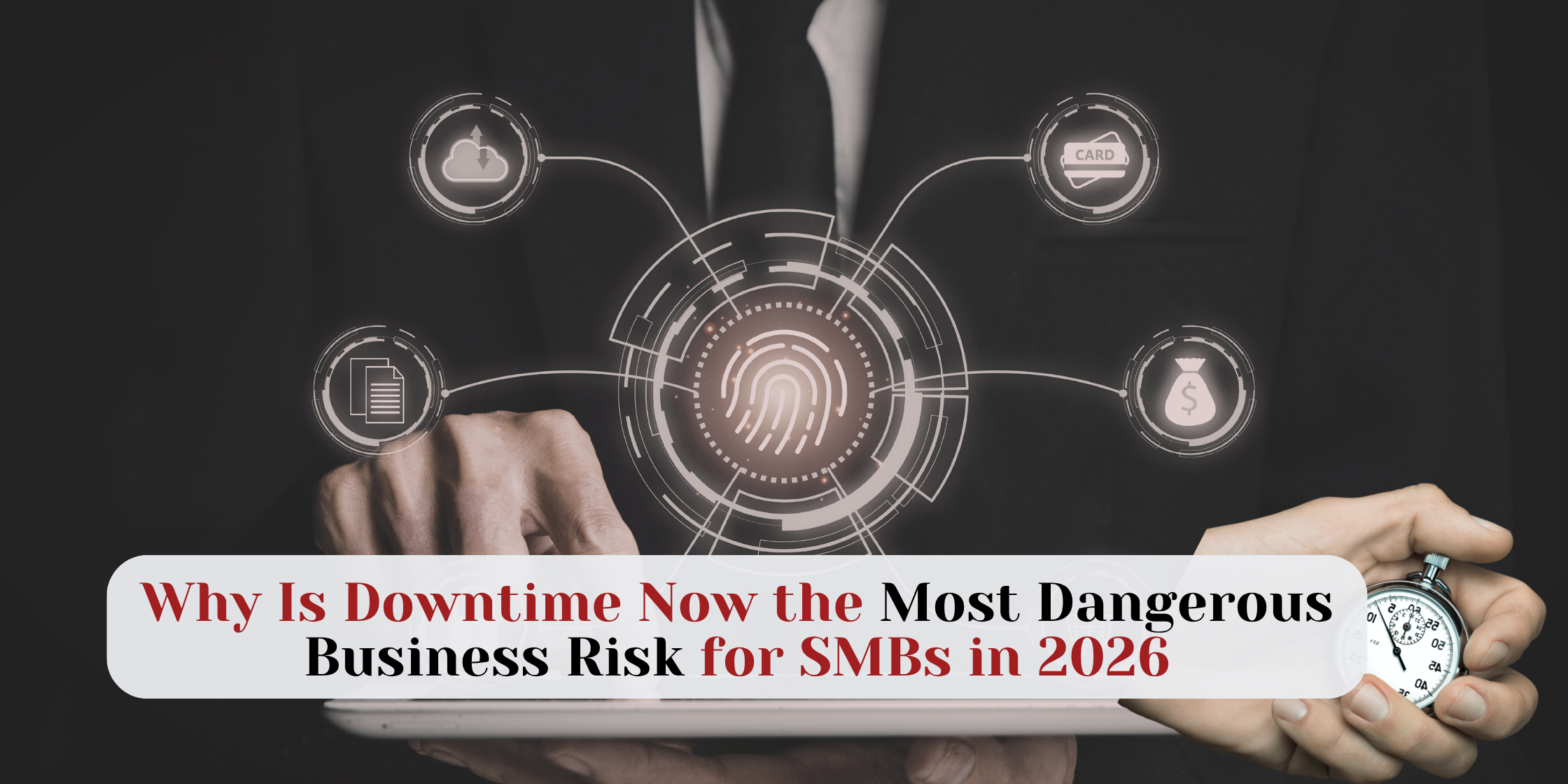
- In 2026, downtime – not just cyberattacks – is the cost that hurts businesses most.
- Even short outages now stop revenue, operations, and customer service instantly.
- Prevention alone cannot eliminate disruption in modern digital environments.
- The organizations that recover fastest now hold the competitive advantage.
What Changed and Why It Matters Now
For years, cybersecurity strategy focused on keeping threats out.
Companies invested heavily in prevention tools:
- firewalls
- endpoint protection
- email filtering
- vulnerability management
These defenses remain important. But the business environment has changed.
Modern companies rely on deeply interconnected digital systems, including:
- cloud infrastructure
- SaaS applications
- remote work platforms
- vendor integrations
- automated supply chains
This interconnected environment creates a new reality:
Business operations can stop instantly when a single system fails.
Today’s outages are no longer caused only by cyberattacks. They also come from:
- cloud provider outages
- software updates breaking systems
- Vendor service disruptions
- configuration errors
In other words, the question is no longer if disruption happens, but how quickly the organization can recover.
That is why resilience – not just prevention – has become the defining capability of modern IT leadership.
Organizations building resilience often align their strategy with guidance from frameworks such as the NIST Cybersecurity Framework, which outlines how companies can improve their ability to identify, protect, detect, respond, and recover from disruptions.

CEO Implications
For CEOs, downtime directly affects growth, reputation, and customer trust.
When systems go offline, the consequences spread quickly across the organization:
- sales transactions stop
- employees lose access to tools
- production and logistics halt
- customer service becomes unavailable
In many industries, even a short outage creates immediate customer impact.
The strategic issue for CEOs is not technical performance. It is organizational continuity.
Forward-looking leaders increasingly work with technology partners such as Advanced Business Solutions to ensure their IT infrastructure supports operational resilience rather than becoming a single point of failure.
CFO Implications
For CFOs, downtime has become a measurable financial risk.
The cost of downtime now includes multiple layers of exposure.
Direct financial losses
- lost revenue during outages
- productivity loss across departments
- emergency recovery costs
Indirect financial impact
- service level agreement penalties
- regulatory exposure
- customer compensation
- insurance claim complications
In many cases, the largest cost is lost business momentum.
When systems fail, deals stall, operations slow, and customer confidence weakens.
Government agencies increasingly warn businesses about the financial risks of downtime and cyber incidents. The Cybersecurity and Infrastructure Security Agency (CISA) provides guidance on building resilience and business continuity.
CIO Implications
For CIOs, the operational model is shifting from defense-first to resilience-first.
Traditional IT strategies assumed prevention would eliminate most disruptions. In modern environments, that assumption no longer holds.
Technology leaders now focus on three core resilience capabilities.
Rapid recovery
Systems and data must be restored quickly after an outage.
Operational continuity
Critical business functions must continue even when parts of the infrastructure fail.
Validated recovery plans
Recovery procedures must be tested regularly to ensure they actually work.
Technology partners like Advanced Business Solutions help organizations implement resilient infrastructure, backup strategies, and disaster recovery frameworks that support these goals.
Core Risk or Opportunity
The core risk facing SMBs today is extended operational downtime.
Research consistently shows downtime can cost organizations thousands – or even millions – of dollars depending on industry and scale.
According to industry analysis published by Gartner, the average cost of IT downtime can exceed thousands of dollars per minute for many organizations.
Common causes of extended outages include:
- incomplete backup coverage
- slow data restoration processes
- undocumented recovery procedures
- vendor dependencies outside the company’s control
The opportunity lies in building operational resilience as a strategic capability.
Companies that can restore operations quickly gain:
- stronger customer trust
- reduced financial exposure
- improved cyber insurance positioning
- greater operational stability
In modern markets, resilience is increasingly a competitive advantage rather than just a defensive measure.
What Smart SMBs Are Doing in the Next 30–90 Days
Leading SMBs are taking practical steps to strengthen resilience.
1. Running executive incident simulations
Leadership teams practice decision-making during outages and cyber incidents.
2. Testing backup recovery speeds
Companies validate whether data can actually be restored within required timeframes.
3. Identifying operational single points of failure
Critical systems and vendor dependencies are mapped and evaluated.
4. Aligning IT resilience with business continuity planning
Technology recovery strategies are tied directly to operational priorities.
5. Partnering with experienced IT providers
Organizations increasingly work with firms like,
Advanced Business Solutions, to design resilient infrastructure, cybersecurity frameworks, and disaster recovery strategies.
Common Mistakes
Several mistakes repeatedly increase downtime risk.
Mistake 1: Assuming backups equal recovery
Backups only help if they can be restored quickly and reliably.
Mistake 2: Treating resilience as a technical project
Operational continuity requires cross-department coordination, not just IT tools.
Mistake 3: Ignoring vendor dependency risk
Many outages originate from third-party services outside the company’s control.
Mistake 4: Never testing recovery plans
Unvalidated recovery procedures often fail during real incidents.
Avoiding these mistakes significantly reduces business disruption.
FAQs
What is the real cost of downtime for SMBs?
The cost of downtime includes lost revenue, productivity loss, operational disruption, recovery expenses, and reputational damage. Even short outages can significantly affect business performance.
Why is downtime increasing in modern businesses?
Downtime is increasing because organizations rely heavily on interconnected systems such as cloud platforms, SaaS applications, and vendor services. Failures in any part of this ecosystem can disrupt operations.
What is business resilience in IT?
Business resilience refers to an organization’s ability to maintain operations or recover quickly after technology disruptions, cyber incidents, or infrastructure failures.
Why is resilience more important than prevention in 2026?
Modern IT environments are complex and interconnected, making it impossible to prevent every incident. Rapid recovery minimizes operational and financial damage when disruptions occur.
How can SMBs reduce downtime risk?
SMBs can reduce downtime risk by implementing tested disaster recovery plans, strengthening backup systems, identifying operational dependencies, and working with experienced IT partners such as Advanced Business Solutions.
What is Business Downtime?
Business downtime is any period when critical systems, applications, or digital infrastructure are unavailable, preventing employees, customers, or partners from completing normal operations.
Downtime can result from:
– cyberattacks
– cloud outages
– software failures
– vendor disruptions
– configuration errors
In modern digital organizations, downtime directly impacts revenue, productivity, and customer trust, making resilience a core business priority.
Bottom Line
Downtime has quietly become one of the most expensive risks facing SMB organizations.
Prevention remains necessary, but it is no longer sufficient.
In 2026, the organizations that succeed are those that can recover quickly, maintain operations during disruption, and protect business continuity when technology fails.
This is where experienced partners play a critical role – helping businesses design resilient technology environments that protect operations, revenue, and customer trust.